
The self-managed company: at Régitex,
leadership moves freely
At Régitex, hierarchy is a living thing.
The production management position was eliminated, and its responsibilities handed to the teams who do the work. This way of organizing has a name: the self-managed company.
What is a self‑managed company?
A self-managed company is an organization that has eliminated its chain of command: the people who do the work decide for themselves how to do it, without going through a series of approvals. Régitex, a spinning mill in Saint-Joseph-de-Beauce, has operated on this model since 2012.
Régitex president Kathrine Mathieu sums up the model in five ideas:
- Management built on trust rather than control
- A hierarchy of skills rather than titles
- Distributed leadership
- Shared responsibility
- Creating the conditions for each person to manage themselves
In practice, three things have disappeared at Régitex: the executive committee, hierarchical titles, and the control role assigned to human resources, which has become a supporting role. The Ordre des conseillers en ressources humaines agréés (the professional order of chartered human resources advisors in Quebec) documented this way of working in its Revue RH as early as 2017.
Two authors informed the approach: Patrick Lencioni, on how teams function, and Frédéric Laloux, whose book Reinventing Organizations describes organizations with no command hierarchy. The term “entreprise libérée” (self-managed company) comes from Isaac Getz, who hosted Kathrine Mathieu on the Leaderships podcast in March 2026.
Can a company with no hierarchy have a president?
Yes, and Régitex has one. The hierarchy that was abolished is that of the daily chain of command, not the ownership of the company or its public representation.
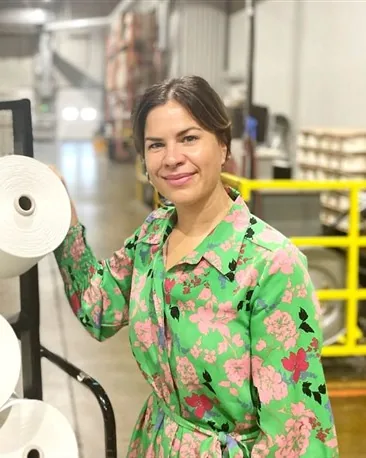
The change began when the production manager left, under Lisa Fecteau, who became sole owner in 2012: the position was eliminated and its tasks handed to the teams. Kathrine Mathieu has been president of the company since May 2022.
How decisions are made, in practice
The principle fits in one sentence that we often repeat:
The one who does is the one who knows.
A decision is made by the people who have the skills to make it, at the scale the decision requires. Some are settled among the people who know the issue best. Others go through several company meetings, because they affect several people. There is no single format, and no office where a decision has to be escalated.
Investments and budgets follow the same logic. Operators and mechanics are consulted on the equipment they will run and maintain, before purchase.
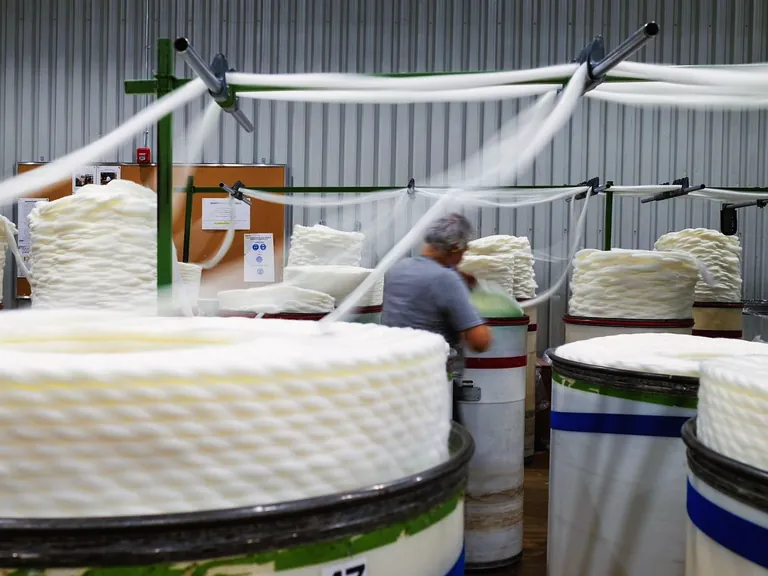
When the production manager left, the hierarchy disappeared
The vision Régitex has given itself: “Seeing further together. To inspire and enrich humanity through the sustainable transformation of the world of technical yarn.”
Lisa Fecteau, who became sole owner in 2012, put in place a management model with no executive committee or hierarchical titles. She was named “Femme d’influence” in 2013, and you can read our vision and our story on the About page.
[…] you are worth far more than your title.
Lisa Fecteau, co-founder of Régitex, in episode 1 of the Libérer pour Grandir channel, May 1, 2026 (translated from French)
What collaborative management changes for you
A management model concerns you only if it changes something about the yarn you receive. Here is what it changes.
Authority follows competence, not title.
A question about settings or specifications can therefore be settled with the person who knows the matter best.
The people who make your yarn chose their tools.
Equipment is purchased after consulting the people who will run and maintain it.
You can document your supplier.
If your company has to report on the social side of its sourcing practices, our management model has been publicly described since 2017 in the Revue RH of the Ordre des CRHA, and the list of the articles that have covered it is further down this page. You are not starting from a statement of intent. The environmental side is covered in our sustainability approach.
What the model demands, and why we say so
A self-managed company is not a company that is easier to run.
Maintaining collaborative management demands constant evolution. You have to come back to it, year after year.
The model asks people to talk about tensions instead of letting them build up, which keeps it in constant motion and very much alive. At Régitex, a tension is the friction felt when there is a gap between what is and what could be better, and it is named in an appropriate setting, such as a team meeting. A tension that is welcomed and expressed clearly becomes a source of growth for the person, the team and the company.
When a conflict arises, Régitex recommends the F.I.E.R. method to guide the conversation: facts, impact, emotion and need, then a search for a shared solution. Written ground rules also frame these conversations, for example using “I” statements and daring to speak honestly, even when it is uncomfortable.
- Facts Say what happened: who, when, what, how, where.
- Impact Name the effect on yourself, on the team or on the organization.
- Emotion and need Say the emotion you feel and the need behind it, using “I”.
- Look for a solution Listen to the other person and find a shared solution together.
Régitex’s ten ground rules:
- Speak in the first person
- Take responsibility for what you say
- Leave your ego aside
- Dare to speak the truth
- Let each person finish speaking
- Welcome silences
- Prefer “yes, and” to “yes, but”
- Respect confidentiality
- Offer a safe and caring environment
- Keep the freedom to leave a meeting, consciously and respectfully
The Régitex Experience guide names three pillars of growth. Responsibility: each person answers for the costs and gains of their projects, and looks after their own needs and tensions. Authenticity: daring to speak, to listen and to question oneself, in service of the common good. Emotional maturity: recognizing what we experience and expressing it with clarity and kindness, with a touch of humour.
We say so because a rare model presented without its trade-offs is not credible, and because the people considering working at Régitex deserve to know what they are committing to.
Recognition and media coverage
Third parties have examined Régitex’s way of working and given it awards.
Human resources management awards
- 2017: Jarret Femme de l’année (Woman of the Year)
- 2013: “Femme d’influence” (Woman of Influence), awarded to Lisa Fecteau
- 2010 and 2013: Grande œuvre de l’industrie en RH (major HR achievement for the industry), CSMO Textile; 2011: Top créativité en RH (top HR creativity), Soirée des Sommets
- 2002: Jarret d’Or, human resources category
Documentation and media
- Leaderships podcast, March 2026: Kathrine Mathieu as a guest of Isaac Getz
- Isarta, 2024: on the link between the management model and the eco-responsible transition
- Le Soleil, 2021: “L’essor de l’entreprise sans patron”
- Revue Gestion, HEC Montréal, 2020: Régitex among three SMEs with a participative management model
- Revue RH of the Ordre des CRHA, 2017: case study on the abolition of the executive committee and titles
- Radio-Canada, Les éclaireurs program: on the elimination of the production management position
- L’actualité: “Bye-bye boss”
Who decides on your request
When I write to you, who decides what happens next with my request?
The subject-matter expert, or the person at the source of the project, decides what happens next. We apply Peter Koenig’s source principle. To write to us, go through the Contact us page.
Which trades can people practise at the plant?
Three trades accept unsolicited applications, even without a posted opening: production operator, industrial mechanic, electromechanic. In production, training is provided in-house. Details are on the Careers page.
What do you offer the people who work at Régitex?
A time bank to take a breather when personal life demands it, and remote work for administrative staff. All the benefits are presented on the Careers page.
How are decisions made at Régitex?
Production decisions are entrusted to the teams, collectively. That is what “flat organization chart” means when you live it every day. On the floor, a person can voice their tensions (if something chafes, it gets said, not endured), get involved in the company’s projects and activities, take part in decision-making and ask for help, which is welcomed. Decisions are sometimes made among the people who know the matter, sometimes at a company meeting. We say it openly: this model takes upkeep, and we are still adjusting it.
What does Régitex measure, and who leads this effort?
Every order that leaves the plant goes out with its carbon footprint, calculated in-house using a methodology reviewed by the independent firm CCG Climat. We provide the carbon footprint of your order dynamically. An R&D pilot project produced prototype flame-resistant underwear and hoods with 10% recycled fibres in the underwear (mostly manufacturing offcuts, pre-consumer) and 12% in the hoods (post-consumer). These prototypes passed the tests set out in NFPA 1970-2025. It is a proof of concept: these yarns are not in our catalogue. This effort is led by the current management: Kathrine Mathieu, president since May 2022, and Emmanuelle Gélébart, sustainable impact strategist.
Want to learn more about our approach to collaborative management?
Our yarn is spun in Quebec, in Saint-Joseph-de-Beauce, by 65 people who decide how to make it.