
Flame-resistant and aramid yarn Safety
Flame-resistant and aramid yarns
for protective textiles
Quote within 24 business hours
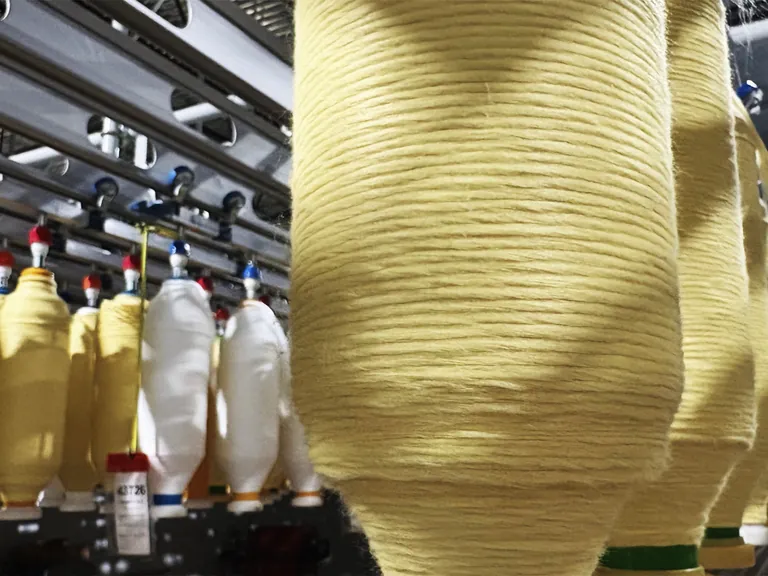
A flame-resistant yarn resists flame without fuelling it. An aramid yarn stands up to heat and abrasion. Régitex spins both in Saint-Joseph-de-Beauce, Quebec, for the weaving and knitting companies that supply the protection market.
The flame-resistant underwear and hood prototypes from the R&D pilot passed the flammability and composition tests set out in NFPA 1970-2025, carried out by an independent laboratory.
The analysis service examines fibres before they enter production, and most of the coloured fibres we spin are solution-dyed. Your quote goes out within 24 business hours.
Quote within 24 business hours · Orders from 2,000 lb · Spun in Quebec since 1998
Which protective garments use Régitex yarns?
Régitex spins for the following protection segments. Its customers are weaving and knitting companies: the finished garment can carry their brand, and Régitex yarn ends up in the layer that has to hold up.
Firefighting
Firefighter garments, including flame-resistant underwear and hoods.
Police
Police uniforms and equipment.
Safety and high visibility
Safety uniforms and high-visibility clothing.
Electrical protection
Lineworker garments and protection against electric arcs (arc flash).
Welding
Welder garments exposed to spatter and radiant heat.
Gloves
Protective gloves.
Energy utilities
Flame-resistant workwear programs.
Motorsport
Racing apparel.
Para-aramid or meta-aramid: which for which risk?
In a protective garment, the choice between a para-aramid and a meta-aramid depends on the risk to be covered. Para-aramid resists tension and cutting, meta-aramid holds up better to heat and stays more flexible, and the blend is used to balance the two. The definitions of the two families and their chemistry are on the Technical information page.
Two families often come up in Régitex blends, aramids and flame-resistant cellulosics. Flame-resistant cellulosic fibres bring comfort against the skin and are blended with aramids to balance cost, hand and performance. The other fibre families Régitex makes its yarns from are detailed on the Technical information page.
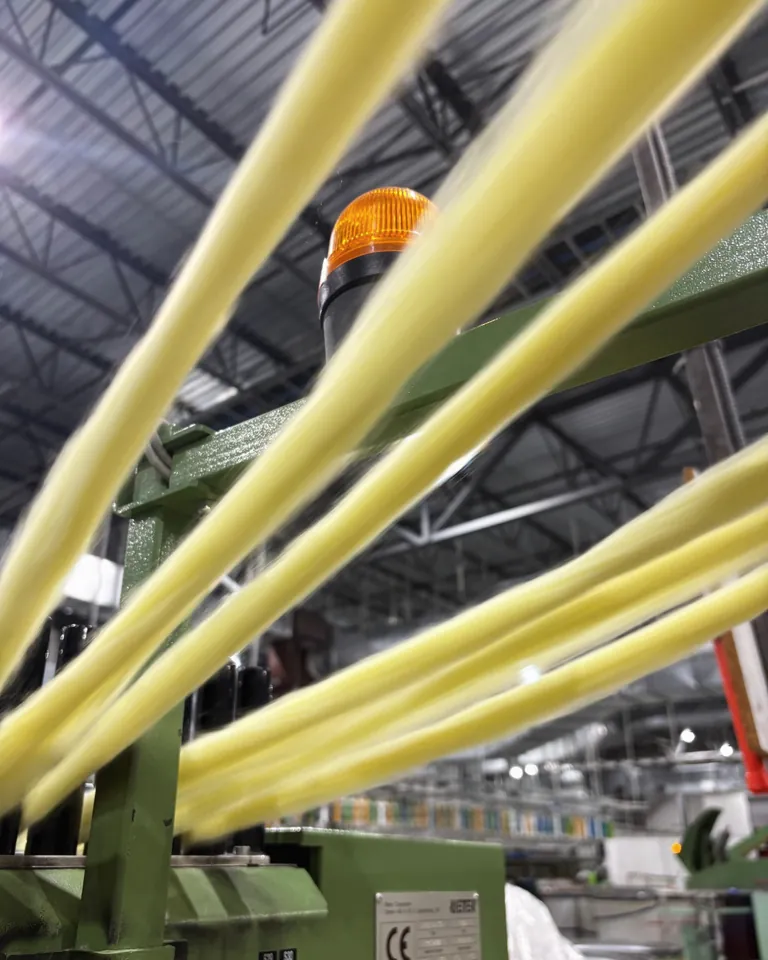
How the yarn is built. Spinning is done in two ways: ring spinning (ring spun) and open-end spinning (open-end). Yarns come out single or plied, with 2 to 4 plies. Every order goes through the mill’s ten steps, from receiving the bales to shipping the cones.
Colour, analysis and small runs
Colour blending in-house. Most of the coloured fibres we spin are solution-dyed: the dye is incorporated into the fibre as it is produced, rather than applied to its surface afterward. The requested shade is then created by blending fibres that are already dyed, which gives control over trade colours and consistency from one lot to the next. Colour development is part of what we offer.
The analysis service. The analysis service examines the fibres and yarns that go into your program, and advises your teams on their machine settings. Cone winding gets the same care as the yarn itself.
Custom work, from 2,000 lb. Orders start at 2,000 lb. A blend development, a colour trial or a small run therefore does not have to wait for a full production volume.
Which standards do Régitex yarns help meet?
Régitex yarns are not certified directly: certifications are usually granted to fabrics and finished garments, which its customers have qualified on their own. The yarns can, however, be designed to meet the requirements of many industry-recognized standards, including those of NFPA, ASTM, ISO, OEKO-TEX, BNQ, CATCC, AATCC and EN.
Can recycled fibres be incorporated into a flame-resistant yarn?
An R&D pilot showed that it can be done, within certain limits: prototype flame-resistant underwear and hoods incorporating 10% recycled fibres (underwear) and 12% (hoods) were produced, and they passed the tests set out in NFPA 1970-2025. The pilot is a proof of concept that can be replicated: as with all Régitex yarns, the recipe is custom-developed for each production run. The project is detailed on the Sustainability page.
Before starting the work, Régitex had ROBIC carry out a freedom-to-operate search on a yarn incorporating 5-30% recycled fibres from used flame-resistant garments. More than thirty-three patents were reviewed. Two could have hindered the project; Régitex does not infringe them, because its fibre blends are different and no thermal treatment is applied to the fibres. The 5-30% range is that of the technology studied; the trials themselves stopped at 10% (underwear) and 12% (hoods).
And for every order, including those that contain no recycled fibre: we provide the carbon footprint of your order dynamically, a practice still uncommon in our industry.

Choosing the right protective fabric
What properties are needed in a protective fabric?
Fire resistance, breaking strength, cut resistance and colour stability. Our in-process controls are described on the Expertise page.
What happens to the fibre waste from your production?
Our fibre waste, clean or soiled, is resold to be made into new products. We are also working to reduce the waste we send to landfill, such as wood and plastic. Our approach is presented on the Sustainability page.
What yarn sizes can you produce?
Our single yarns range from 4 to 38 Ne (cotton count), or about 15 to 147 tex. Plied yarns can go up to 40 Ne, usually in 2 to 4 plies. The full table is on the Technical information page.
Our markets
Protective textiles
Industrial textiles
Furnishing and apparel
Medical textiles
Military textiles
Get a protective yarn quoted
Specify the fibre or blend you are targeting, the yarn size, the colour and the volume. You get your quote within 24 business hours. Specification not settled yet? Describe the end application, the one that has to withstand flame or arc flash, and the technical team takes over.