
Recycled yarn Sustainability ESG
Spinning toward
responsible living
A self-managed company that thinks long term.
Our approach
The carbon footprint of your order
We provide the carbon footprint of your order dynamically, a practice still uncommon in our industry. It comes from our GHG inventory, calculated in-house according to the GHG Protocol following a materiality assessment, and whose methodology was reviewed by the independent firm CCG Climat. Nearly 90% of emissions come from fibre consumption, and the model’s absolute margin of error is ±5 percentage points. The footprint covers the fibre as spun, before dyeing and finishing. If most of a yarn’s carbon weight is decided by the choice of fibre, the useful conversation takes place during design.
Nearly
90%
of emissions come from fibre consumption, within ±5 points
measured in CO₂ equivalent
Our commitments
Yarns made from recycled fibres
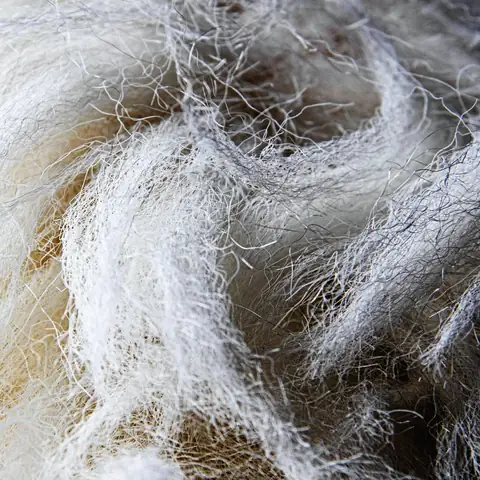
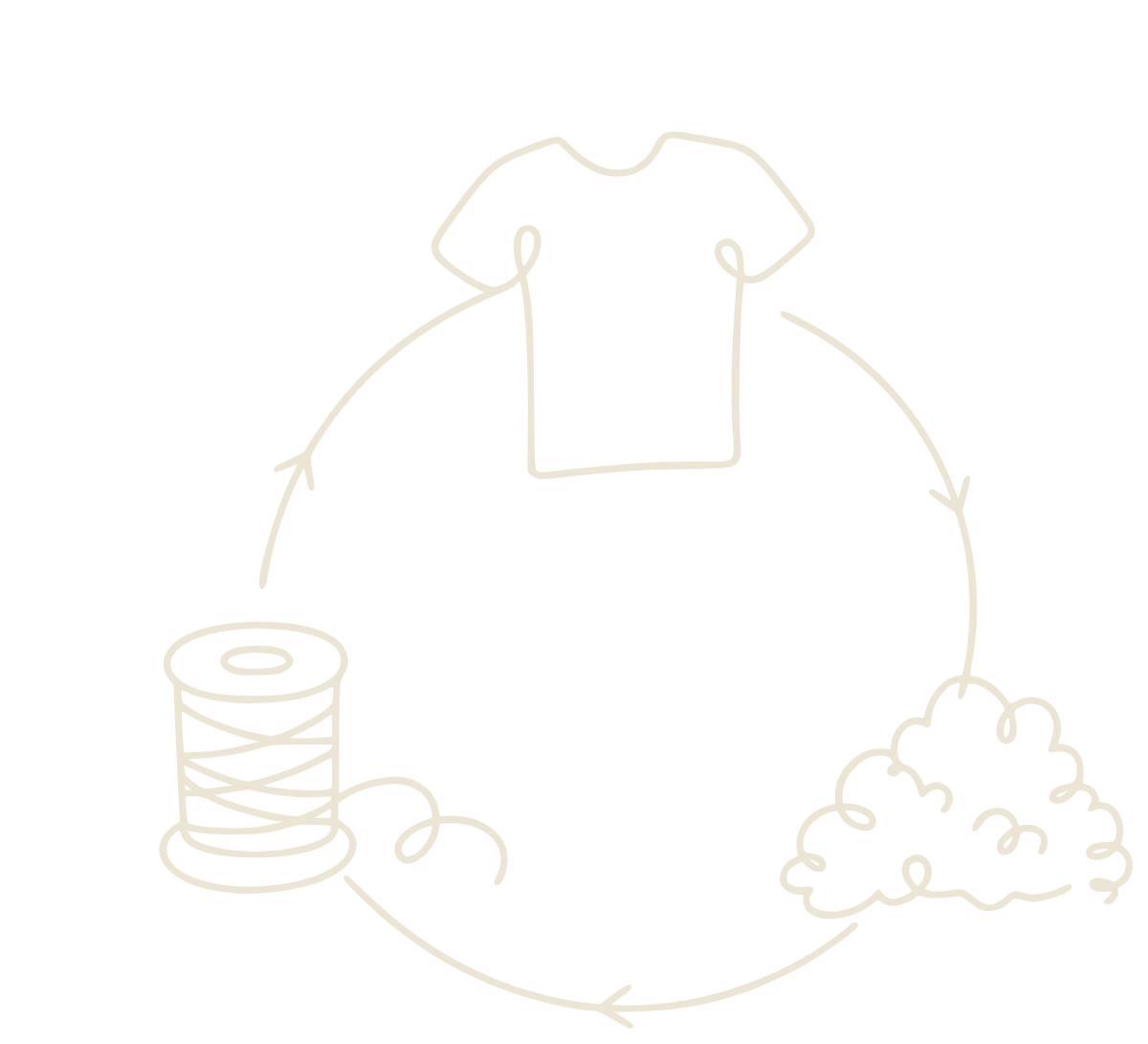
Recycled fibres
The use of recycled fibres is assessed according to the application and the specifications.
- Recycled fibres, pre- and post-consumer
Custom integration
The fibre is chosen according to the application and the project specifications.
- Each project is assessed according to its needs
Spun in Quebec
Both spinning processes, ring and open-end, share the same roof.
- Production in Saint-Joseph-de-Beauce
Keeping materials in circulation
Throughout production, the team works to limit raw material losses and divert as much material as possible from landfill.
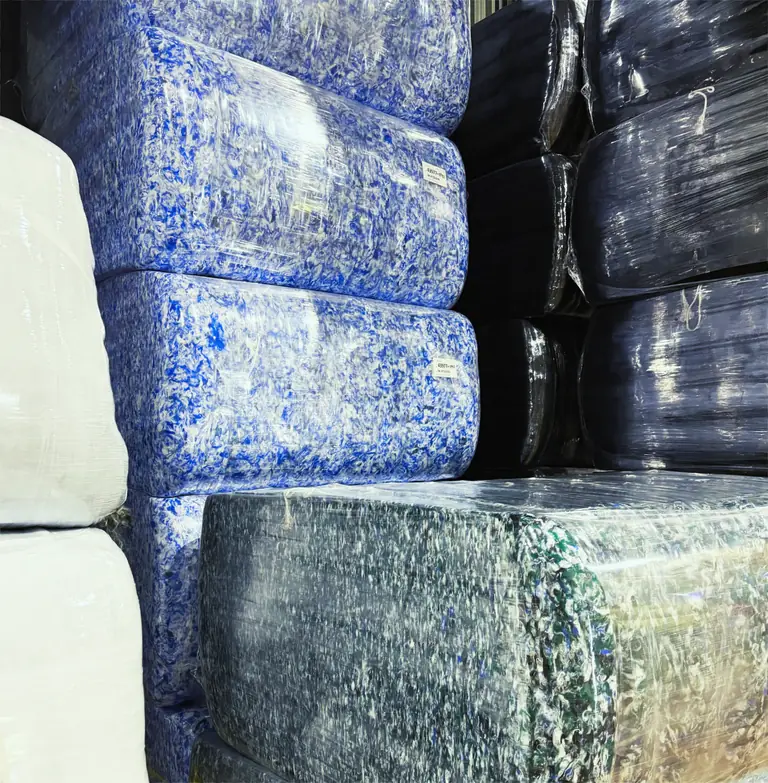
Fibre recovery, on three levels
- Clean fibres, still at an early stage of processing, go back into the production cycle.
- Slightly contaminated but highly processed fibres are sold to a company that turns them into insulation panels.
- The rest finds other uses. For example, the start-up Texélan has made decorative tiles from it.
All three levels are measured in the carbon footprint.
Other materials
- Non-conforming bobbins are donated to the Cercles de Fermières du Québec, who use them for crafts.
- Raw material tarps become covers that shield bobbin carts from light and dust.
- Wooden crates from new machines are offered to staff, who turn them into flower boxes, shelves or shed reinforcements.
- Separators placed between bobbins come back from nearby customers and are reused several times.
- Plastics are sorted, baled and weighed in-house so each type can be recovered separately.
The Net-Zero Challenge
Régitex has committed to this Environment and Climate Change Canada program to structure its path to net zero.
R&D project
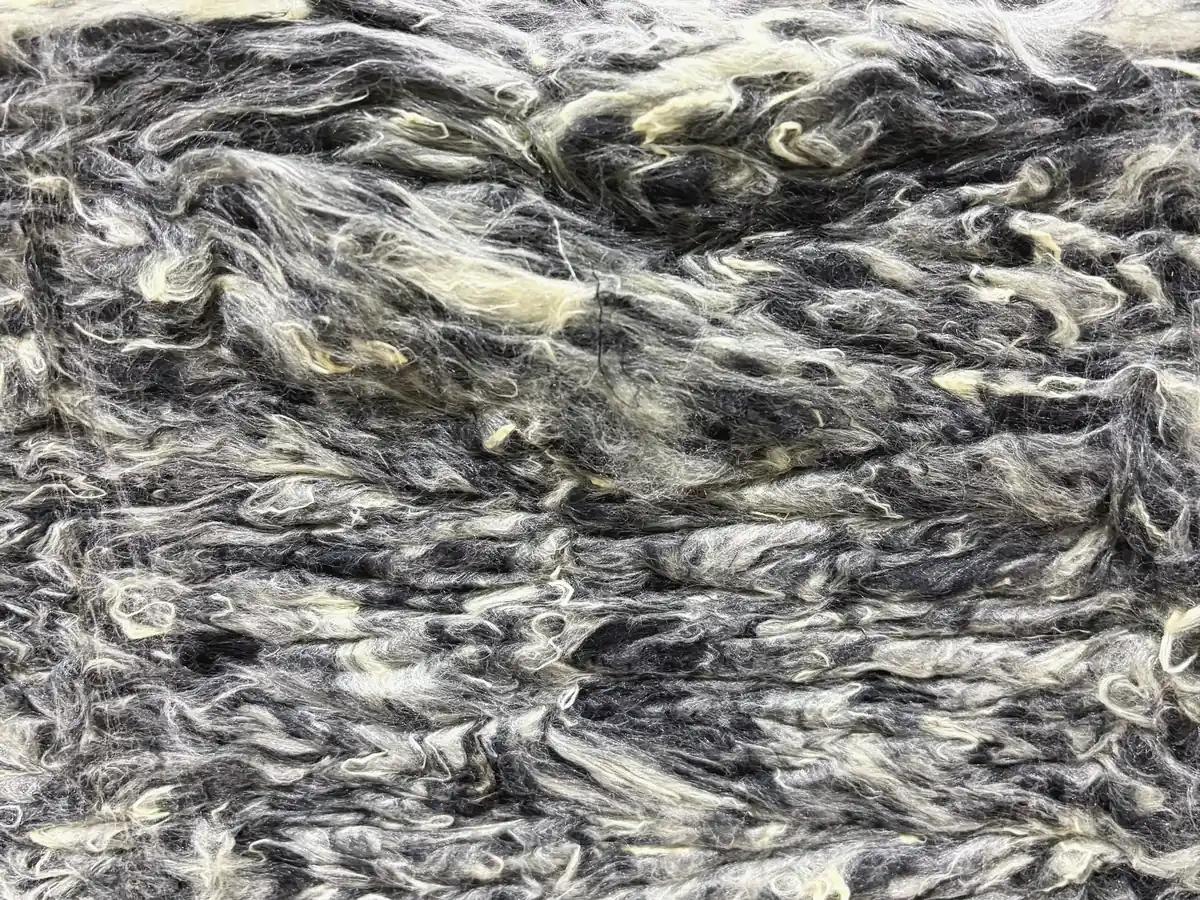
An R&D pilot project on recycled fibres
In this pilot project, Régitex developed a yarn for protective clothing from end-of-life uniforms, collected from several municipal services.
- Recycled fibres introduced into the blend in prototypes: 10% (pilot formula, mostly pre-consumer) and 12% (post-consumer), retained share not measured, in line with the NFPA 1970-2025 tests on the prototypes
- Production carried out in Quebec
- The pilot is a replicable proof of concept: as with all our yarns, the recipe is custom-developed for each production run.
Confirmed facts
Our evidence
- Carbon footprint provided for every order, drawn from a GHG inventory calculated according to the GHG Protocol, whose methodology was reviewed by the independent firm CCG Climat
- Bronze tier in the Net-Zero Challenge of Environment and Climate Change Canada
- Yarns spun in Quebec, in Saint-Joseph-de-Beauce
Traceability and carbon inventory
Which fibre families do you spin?
The fibre families we spin, recycled or not, are described on the Technical information page.
What does a “dynamic” GHG inventory mean?
Our GHG inventory updates as soon as new data comes in, such as an invoice. Some data is reviewed according to how likely it is to change: home addresses, for example, are checked once in the summer, after the moving season, and once in the winter. For a quote, go through the Request a quote page.
Which recycled fibres go into our yarns?
Régitex uses recycled fibres in both ring spinning and open-end spinning, depending on the application and on the performance and certification requirements of the finished product. Not every application accepts them, and we would rather tell you before you order.
Most of the coloured fibres we spin are solution-dyed: the colourant is built into the fibre as it is produced, rather than applied to its surface afterwards. The colour is part of the fibre.
Can yarn be made again from used flame-resistant garments?
An R&D pilot project showed that it can, up to a certain rate. The prototype yarns contain 10% recycled fibres for the underwear (mostly pre-consumer) and 12% for the hood (post-consumer), introduced into the blend according to the pilot formula; the share actually retained was not measured. These yarns were used to make prototype flame-resistant underwear and hoods that passed the flammability and composition tests set out in NFPA 1970-2025, carried out by an independent laboratory. The pilot remains a proof of concept: these yarns are not in our catalogue.
Where do a yarn’s emissions come from?
Our carbon footprint model breaks greenhouse gas emissions down as follows: about 90% come from fibre consumption, depending on the type of yarn; about 5% from transport, excluding Italy; less than 0.5% from electricity; and about 4.5% from everything else (staff travel, heating gas, leaked air-conditioning gas, operating waste). According to our carbon footprint model, the absolute margin of error of the breakdown is ± 5 percentage points. Our internal GHG emissions reduction target (2022 baseline) is -29% by 2030 for Scopes 1 and 2 and -46% by 2035.
What circularity changes, and what it does not
For a spinner, circularity comes down to two actions: spinning here rather than elsewhere, and finding an outlet for the material that is left over.
Spinning takes place in Saint-Joseph-de-Beauce, which shortens the yarn’s trip to you. The fibres themselves are bought internationally, in Europe and in Asia, and transport accounts for about 5% of our emissions while the fibre itself accounts for about 90%. Spinning close to you therefore shifts a small share of the footprint, not the large one. What shifts the large share is the material you choose, which is why the useful conversation happens during design rather than at shipping.
What sustainability changes in how we are organized
It changes who decides. At Régitex, 65 people work without a management committee or hierarchical titles. Depending on the issue, a decision is made among the people who know the file, or at a company meeting. This model is demanding to maintain, and we say so publicly.
Where does each number on this page come from?
Each number comes from a named source, and estimates are identified as such. The emissions breakdown comes from Régitex’s carbon footprint model, calculated in-house, whose methodology was reviewed by the independent firm CCG Climat. The 10% and 12% recycled fibre rates and the prototypes’ test results under NFPA 1970-2025 come from Régitex’s R&D pilot project.
We do not show a company-wide recycled content rate, consolidated emissions or an overall emissions reduction here: those numbers are not validated for publication. We would rather leave a box empty than print an approximate number.
The carbon in your yarn comes down to the choice of fibre. Shall we talk before production?
The choice of fibre accounts for most of your yarn’s GHG emissions. This conversation is best held during design, and our analysis service takes it on.